The main difference between a live front and a dead front padmount transformer is how you can access the energized parts.
One design leaves the terminals exposed, while the other keeps everything fully covered and insulated. The transformer bushing controls this key difference.
This guide compares safety, maintenance, cost, and common uses so you can pick the right design for your power system.
A transformer bushing is an insulated path that lets electricity move safely through the metal wall of a transformer. It acts as a sealed gateway, keeping the conductor separated from the grounded tank around it.
The way these bushings connect to the outside world is what makes a transformer either live front or dead front.
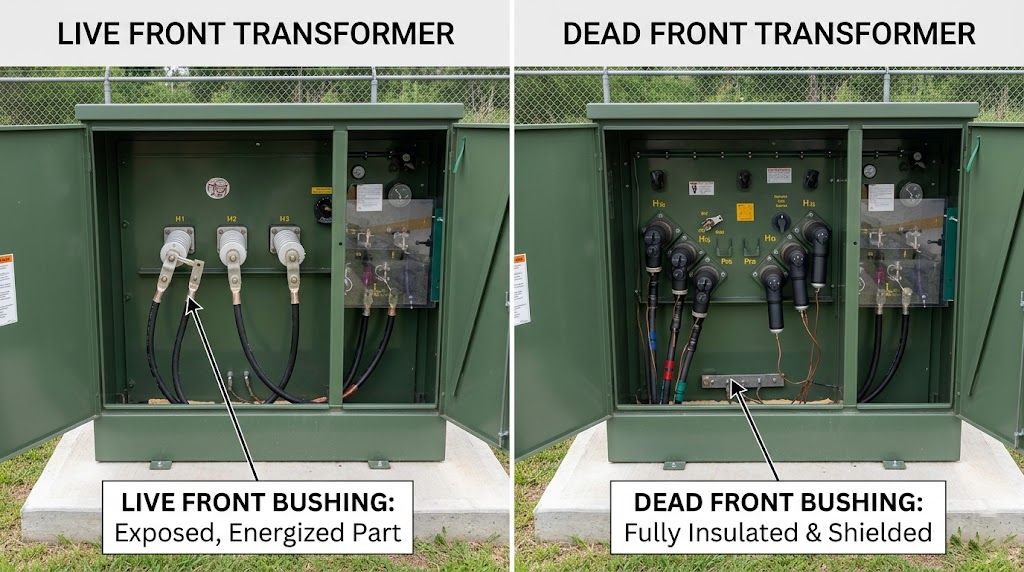
The live front transformer is the older style, and it has exposed high-voltage connection points on the outside. It has been used for decades, but you see it less often in public spaces today.
The live front design costs less upfront, and its parts are simple and easy to inspect with your eyes.
The downsides are serious: it creates a high risk of arc flash and electric shock, it needs a larger cabinet to keep safe distances between parts, and it can only be used in locked-off areas away from the public.
Many utilities still use the live front standard for specific controlled sites, but safety concerns push most new projects in a different direction.
The dead front transformer is now the standard for safe power distribution. Every energized part is fully covered, so no one can accidentally touch a live connection.
The biggest benefit of dead front design is much better safety, since the risk of arc flash drops sharply.
It also fits into a smaller cabinet, which makes it work well in neighborhoods and other public spots.
The tradeoffs are a higher upfront cost and the need for special tools and trained workers. You also cannot see the connection points directly, since they are hidden inside insulation.
The shift toward dead front design shows that the industry treats safety as a top priority. For any project where workers or the public might be nearby, it pays to work with makers who follow these modern standards.
To see how these safety features come together in well-built units, explore CNC complete range of modern pad-mounted transformers.
A side-by-side look at these two designs helps engineers and planners weigh the key factors for their projects.
| Feature | Live Front Transformer | Dead Front Transformer |
|---|---|---|
| Safety | High risk of arc flash and shock; exposed live parts. | Significantly safer; all live parts are insulated and shielded. |
| Maintenance | Simple to look at, but needs a full power shutdown and heavy protective gear. | Safer for some tasks like loadbreak switching, but requires special tools and training. |
| Initial Cost | Lower. | Higher. |
| Footprint | Larger because of air clearance needs. | More compact; reduced clearance needs. |
| Ideal Application | Secure, restricted-access areas like fenced substations or industrial sites. | Publicly accessible areas like residential neighborhoods, shopping centers, and parks. |
Arc flash is a sudden, dangerous burst of energy that can seriously injure workers.
Exposed terminals on a live front unit raise this risk, while the fully shielded dead front design keeps that danger much lower. Maintenance works differently for each type.
A dead front transformer with loadbreak elbows lets workers do some tasks while the unit is still energized, which cuts downtime.
Most work on a live front unit, by contrast, requires a full shutdown and strict safety steps before anyone gets close.
This ability to work on an energized system is one big reason dead front design has become so popular.
Use this checklist to guide your choice and make sure you pick the right transformer for your situation.

In the field, the difference between these two designs is something you feel right away. Technicians who work with dead front transformers regularly say they feel much more confident and safe on the job.
Live front transformers still fit certain older, tightly controlled sites, but the industry is clearly moving toward the safer and more compact dead front design. For nearly every new installation, especially near people or public spaces, dead front is the right call.
The final decision balances safety, location, and total cost. Safety, though, should always come first.
Picking the right transformer protects your people and your infrastructure for years to come. If you need help choosing a unit or want expert guidance, reach out to CNC team and let us help you find the right option from our full selection of high-quality transformers today.
 Products
 Projects
 Solutions
 Service
 News
News About CNC
 Contact Us