Every modern industrial facility runs on its electrical system. The machinery matters, but without the right power setup behind it, nothing works. Choosing the correct industrial transformer voltages is a foundational decision. It shapes safety, efficiency, and what you spend to keep the lights on.
In industrial settings, electrical power is distributed at two main levels. The first is Low Voltage (LV), which runs below 1,000 Volts (1kV). The second is Medium Voltage (MV), which runs from 1kV up to 35kV.
This guide walks you through the key differences between LV and MV systems. It will also help you pick the right setup for your facility.
Before comparing, let’s define the standard voltage classifications. These are based on guidelines from organizations like the IEEE and NESC standards.
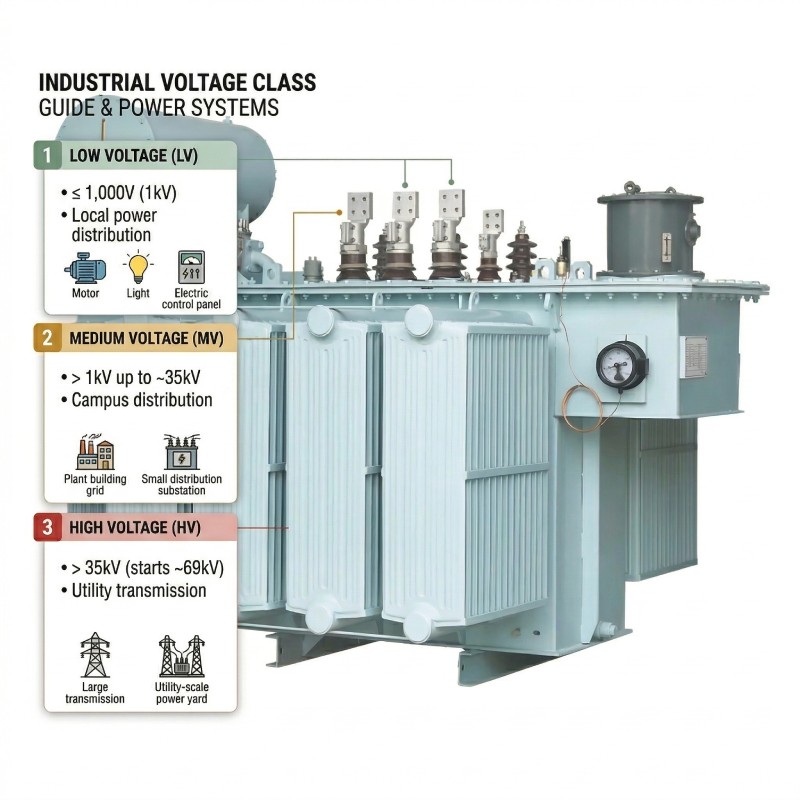
The choice between a low voltage and medium voltage system depends on your facility size, load needs, and distance. Let’s break down the key differences.
| Feature | Low Voltage (LV) System | Medium Voltage (MV) System |
|---|---|---|
| Voltage Range | Typically < 1,000V (e.g., 480/277V, 600V) | 1kV – 35kV (e.g., 4.16kV, 13.8kV) |
| Primary Application | Direct power to machinery, lighting, HVAC, and control panels. | Primary power distribution across a large site or campus. |
| Conductor Size | Requires larger, more expensive copper cables for the same power due to higher current. | Uses smaller, more economical cables for efficient long-distance power transfer. |
| Equipment Footprint | Switchgear and transformers are generally more compact. | Requires larger switchgear, more physical clearance, and often dedicated electrical rooms. |
| Safety Requirements | Standard electrical safety protocols; equipment is often accessible to qualified personnel. | Strict safety protocols, arc flash hazards are significantly higher, requires specialized training and PPE. |
| Typical Use Case | Small manufacturing plants, commercial buildings, workshops. | Large factories, industrial parks, university campuses, data centers, mining operations. |
Power loss is a critical factor here. Because power loss (I²R loss) grows with the square of the current, LV systems waste more energy as heat over long distances. MV systems move the same power at a much lower current, which cuts those losses significantly.
Understanding these differences is the first step. The next step is picking the right hardware. Whether your project needs a step-down unit for a low voltage distribution system or a primary MV transformer, explore our comprehensive catalog of industrial transformers to see models suited for every application.
Features a fully oil-filled, sealed corrugated tank that naturally adapts to oil expansion. Engineered for high efficiency and low loss to significantly save power consumption and operating costs.

Theory is one thing. How it applies to your actual facility is another. In our experience, the decision usually comes down to two common scenarios.
A machine shop, a light assembly plant, or a commercial building under 100,000 sq. ft. fits this profile. A low voltage distribution system is almost always the most practical and cost-effective choice here.
The utility provides service at a low voltage (e.g., 480Y/277V). A single main transformer and switchboard can power the entire facility without a significant voltage drop. The added cost and complexity of MV equipment are simply not needed.
This profile covers a large factory with heavy machinery, a chemical processing plant, or a multi-building campus. A primary medium voltage loop is the standard approach for these applications.
Power moves efficiently at an MV level (e.g., 13.8kV) across the site to smaller, local step-down transformers. Those transformers then create the low voltage distribution systems that power equipment in each specific area. This approach cuts expensive power losses and reduces the need for massive low-voltage cables.
Knowing how many volts in a transformer is only the beginning. A reliable system depends on matching several other key ratings to your load.
Transformers are rated in kVA (kilovolt-amperes), which is the transformer’s apparent power. Do not confuse it with kW, which measures real power only. The kVA rating must cover both the real power doing work and the reactive power that motors need. We recommend sizing your transformer with at least a 20–25% margin to handle future growth and motor startup currents.
Impedance (%Z) controls how much voltage drops under load. A lower impedance transformer gives better voltage stability but allows dangerously high short-circuit currents. A higher impedance unit limits fault currents but can cause voltage to sag when large motors start up. This trade-off is a key engineering decision that requires careful thought.
Industrial environments can be hot and dusty. A transformer’s insulation class sets the maximum temperature it can safely handle, which directly affects its lifespan. Understanding transformer insulation classes is vital for any installation. Whether you choose a dry-type unit for indoor safety or an oil-filled unit for outdoor use depends entirely on your environment.
Choosing the correct industrial transformer voltage is a cornerstone of any safe and efficient industrial operation. Whether you need a facility-wide LV system or a combination of MV distribution with LV step-downs, the right choice makes a real difference.
By understanding the trade-offs between LV and MV and considering ratings like kVA and impedance, you are better prepared to build a system that works today and grows with you tomorrow.
 Products
 Projects
 Solutions
 Service
 News
News About CNC
 Contact Us